

Hearth notes
Black Pepper in Witchcraft: Magical Properties and Uses
What black pepper means in witchcraft: protection and banishing, under Mars and fire. A salt and pepper mix for the door and a soup to cook this week.
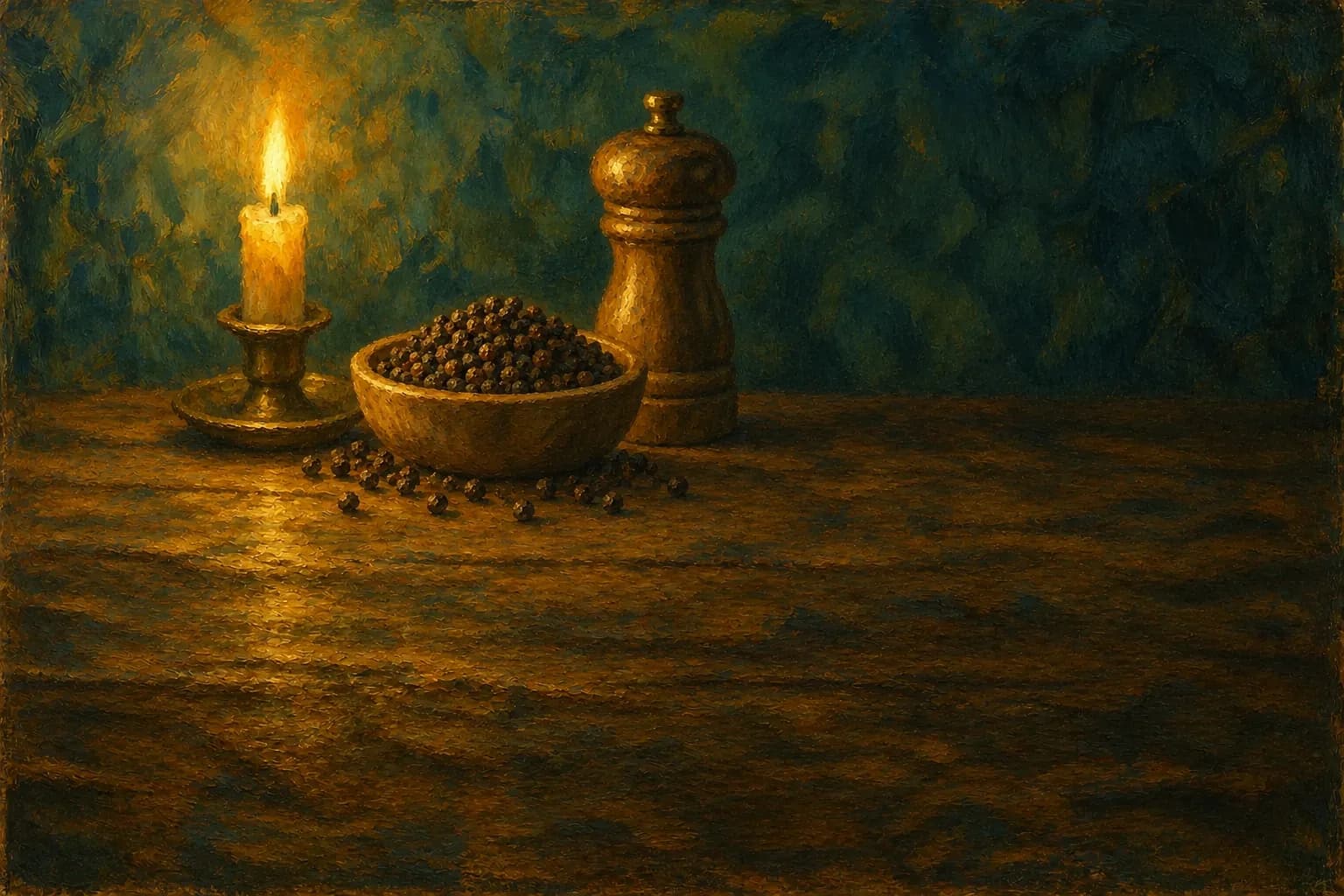
In witchcraft, black pepper is used for protection and for banishing, which means driving something unwanted out of a house or away from a person. Scott Cunningham’s Encyclopedia of Magical Herbs gives it the planet Mars and the element fire, with the powers of protection and exorcism.
Black pepper correspondences at a glance
| Correspondence | Black pepper | Source |
|---|---|---|
| Planet | Mars | Both of Cunningham’s encyclopedias |
| Element | Fire | Both of Cunningham’s encyclopedias |
| Used for | Protection, exorcism | Encyclopedia of Magical Herbs |
| Used for | Protection, purification | Encyclopedia of Wicca in the Kitchen |
| In Hearthlight’s app | Fire and Mars, for protection, courage, energy and clarity | Hearthlight’s own set |
Exorcism is Cunningham’s word. This page says banishing for the same job. The app’s last three uses are its own additions and appear on neither of his lists. Tuesday is the day William Lilly’s Christian Astrology (1647) gives to Mars, if you time a dish by the planet, and Hearthlight’s planner for kitchen witches includes planetary hours. For how black pepper sits beside other ingredients, see the guide to magical correspondences for cooking ingredients.
Four ways to use black pepper this week
The door mix and the carried peppercorns follow Cunningham’s herb book, and the soup follows his food book. Hearthlight supplied the amounts, the dish for an apartment, the toasted pepper and the step of saying it aloud.
Salt and pepper at the door, 1 dish. Cunningham writes of pepper, “Mixed with salt and scattered about the property it dispels evil.” Stir 1 tablespoon (18 g) of table salt and 1 teaspoon (about 2 g) of ground black pepper together in a small dish. Scatter it in a thin line across the outside doorstep and use what is left on the outside windowsills. Say in one plain sentence what is to stay out, then sweep the mix up the next morning. In an apartment, leave the dish on a shelf by the front door overnight and pour it into the trash in the morning. Cunningham guards the same door with a jar of rice.
Peppercorns to carry, 1 small bag. In the same entry, pepper “is added to amulets as a protectant against the evil eye, and when worn it frees the mind of envious thoughts”. Tie 1 teaspoon (about 3 g) of whole black peppercorns into a 4-inch (10 cm) square of cloth with a length of thread. Carry it in a coat pocket or a bag. Whole peppercorns stay inside the cloth where ground pepper would sift out. The bag suits a week when someone else’s envy, or your own, is the trouble. Empty it into the trash when that week is over.
Tomato soup with black pepper, 4 bowls. Cunningham’s food book says, “Add black pepper to protective foods, such as chili, tomato juice, and nachos.” Its entry for tomato lists protection and says to “flavor tomatoes with black pepper, bay, dill, or rosemary”. The same book gives onion to Mars and fire for protection. Hearthlight wrote the recipe. Warm 1 tablespoon of olive oil in a 3-quart (3-liter) pot over medium heat and cook 1 chopped onion in it for 5 minutes, until soft. Add one 28-ounce (800 g) can of whole tomatoes with their juice, 2 cups (480 ml) of water or stock and 1/2 teaspoon of salt. Bring the pot to a boil, lower the heat and simmer uncovered for 20 minutes. Take it off the heat, let it stand for 10 minutes and blend it smooth with a stick blender in the pot. In a jug blender, work in two batches and hold the lid down under a folded towel, because hot soup can push the lid off. Taste it and add salt if it needs it. Stir in 1 teaspoon of freshly ground black pepper, grind a little more over each bowl and say who the soup is for. Refrigerate what is left within 2 hours.
Toasted pepper for the table, 1 jar. Courage is on Hearthlight’s list for black pepper. This jar is for the morning of something you have been dreading. Turn on the fan over the stove. Toast 2 tablespoons (about 17 g) of whole black peppercorns in a dry skillet over medium heat for 2 to 3 minutes, shaking the pan, until they smell strong. Tip them onto a plate to cool for 10 minutes, then crush them coarsely in a mortar or under the base of a heavy pan. Keep them in a closed jar and put a pinch on eggs or buttered noodles.
Where the meaning comes from
In the oldest source here for the planet, the reason is the heat of the spice. Lilly gives Mars the plants whose taste is caustic and burning, and his list for the planet has pepper between mustard seed and ginger. Eating for your birth chart uses that list to give black pepper to Scorpio, one of the two signs Mars rules.
Cunningham also gives Mars, and adds fire. His entry files pepper with the herbs he calls masculine. A note on how to read the entries says those are the herbs “used for protection, purification, hex-breaking, exorcism”, in a sentence that goes on to strength and courage. He names no source for the amulet or the salt.
What to buy and how to store it
Buy whole black peppercorns and a mill. Cunningham’s food book says that “freshly ground pepper is best”, and it warns against overusing pepper or any other spice. McCormick gives whole spices such as peppercorns three to four years on the shelf and ground spices two to four, and says they last longer in a dark cabinet away from the heat of the stove.
Black, white and green peppercorns are all the fruit of Piper nigrum. Black ones are picked full-grown before they ripen and dried whole. White ones are ripe fruit with the outer layer removed. Cunningham’s entry is headed with the plant’s name, so Hearthlight treats white pepper as a stand-in when the black runs out. Chili is a different plant. Cunningham’s entry for chili pepper, which he also calls red pepper, shares Mars and fire and has its own powers of fidelity, hex-breaking and love.
What black pepper cost in Rome
In the first century, Pliny the Elder’s Natural History priced black pepper at four denarii a pound, white at seven and long pepper at fifteen. He could not see the appeal. Its “only desirable quality” was “a certain pungency”, he wrote, “and yet it is for this that we import it all the way from India!” The historian Zosimus records that when Alaric besieged Rome, the city agreed to give him gold, silver, silk robes, scarlet fleeces and three thousand pounds of pepper. Pepper was once costly enough to be part of a ransom. Even so, neither of Cunningham’s entries for it gives a use for money.
Records of black pepper in hoodoo
Hoodoo, conjure and rootwork are related African American traditions. The University of California Press describes conjure, the subject of Yvonne Chireau’s history Black Magic, as “the African American tradition of healing and harming that evolved from African, European, and American elements”. Uses of black pepper in these traditions belong to the people who practice them and are separate from the correspondences above, which come from Cunningham and Lilly.
| Source | What it records |
|---|---|
| Newbell Niles Puckett, Folk Beliefs of the Southern Negro (1926), chapter “Voodooism and Conjuration" | "To make a person leave, put black pepper on your stove” (page 272) |
| Zora Neale Hurston, Mules and Men (1935), the chapter on Father Watson | Reverend Father Joe Watson, “The Frizzly Rooster”, takes her into the workroom and says that “when you want a person punished who is already indicted”, the name goes on a slip of paper in a bowl with “some red pepper, some black pepper” and other things |
| The Lucky Mojo Curio Co. catalogue, on the shop’s herb page | Root doctors use black pepper “to work so-called Enemy Tricks and for Protection”. It is an ingredient in goofer dust, crossing powder and hot foot powder, which are used to jinx an enemy or drive an unwanted person away. Some people sprinkle black pepper and salt after a departing witch, here a person believed to do harm, “to prevent him or her from returning” |
Hurston was a Black writer and anthropologist, and her record gives a practitioner’s own words. Puckett wrote from outside the tradition. He was a white sociologist from Mississippi who collected in the 1920s, through field work and through questionnaires sent to Black colleges across the South. His preface calls the subject “folk-lore and superstition”. On page 190 he writes that in New Orleans he “posed as a real conjure-doctor”, and on page 206 that he “adopted the role of conjure-doctor” to talk with practitioners “as hoodoo to hoodoo”. The Lucky Mojo text is catalogue copy from a shop that sells hoodoo supplies. Its herb pages are written by catherine yronwode, an author who co-owns the shop.
Safety
| Risk | What the source says | Source |
|---|---|---|
| Pepper breathed in | A 1988 report describes eight children who died after breathing pepper into the airway. Seven had been given it as a punishment. The eighth death was an accident, in a child with pica, a habit of eating things that are not food | American Journal of Diseases of Children |
| Salt where a pet can lick it | Too much salt can make a pet thirsty, and the signs of salt poisoning “can include vomiting, diarrhea, depression, tremors, seizures and even death” | ASPCA |
| Piperine capsules taken with medicine | Piperine is the compound that makes pepper hot. Taken alone as a supplement, it interacted with several drugs in the studies reviewed, in most cases raising the amount the body absorbed. The review sets supplements apart from pepper used to season food | Scientists at the German Federal Institute for Risk Assessment, 2021 |
| Soup left on the stove | ”Discard any perishables left out at room temperature for more than 2 hours” | U.S. Food and Drug Administration |
Keep the pepper jar and the door mix where a small child cannot reach them, and never use pepper as a punishment. Do not blow ground pepper at a person or an animal. Treat Puckett’s stove line as a record, since pepper on a hot burner scorches and smokes. Scatter the door mix where no pet will lick it. Anyone who takes medicine and wants a piperine supplement should ask a pharmacist first.
Frequently Asked Questions
What is black pepper used for in witchcraft?
Protection first, then banishing. The pepper entry in Scott Cunningham’s Encyclopedia of Magical Herbs lists protection and exorcism, and has pepper mixed with salt and scattered about a property or carried in an amulet against the evil eye.
What are the magical properties of black pepper?
Protection and exorcism in the pepper entry of Cunningham’s herb book, and protection and purification in his Encyclopedia of Wicca in the Kitchen. Both books give it Mars and fire. Hearthlight’s app keeps Mars and fire and has its own list of uses, with courage and clarity on it.
What element and planet is black pepper?
Fire and Mars, in both of Cunningham’s encyclopedias and in Hearthlight’s app. William Lilly listed pepper among the plants of Mars in 1647, long before either.
How do you use black pepper for protection?
Stir 1 tablespoon of salt with 1 teaspoon of ground black pepper and scatter it across the outside doorstep, which follows Cunningham’s line about salt and pepper scattered about a property. For protection you can carry, tie a teaspoon of whole peppercorns into a square of cloth.
Is cayenne the same as black pepper in a spell?
No. Black pepper is the fruit of Piper nigrum, and cayenne is a chili. Cunningham’s entry for chili pepper shares Mars and fire and lists fidelity, hex-breaking and love, where his entry for black pepper lists protection and exorcism.
Is black pepper safe to use around children and pets?
Keep the jar and the door mix out of a small child’s reach, and never blow ground pepper at a person or an animal. For pets the salt in a door mix is the larger risk, and the ASPCA lists vomiting, tremors and seizures among the signs of salt poisoning. Scatter the mix outside where no animal will lick it and sweep it up the next morning.
Sources
- Scott Cunningham, Cunningham’s Encyclopedia of Magical Herbs (Llewellyn, 1985; expanded edition 2000), the section “How to Read the Entries” and the entries for pepper and chili pepper, read in the 2000 edition.
- Scott Cunningham, Cunningham’s Encyclopedia of Wicca in the Kitchen (Llewellyn, 2003), entries for black pepper (pages 131 and 132), tomato (page 99) and onion (page 89).
- William Lilly, Christian Astrology (London, 1647), chapter X, “Of the Planet Mars”, pages 67 and 68. Scan at the Internet Archive.
- Pliny the Elder, Natural History, book 12, chapter 14, translated by John Bostock and H. T. Riley (1855), at the Perseus Digital Library.
- Zosimus, New History, book 5, in the English translation published by Green and Chaplin (London, 1814), at the Tertullian Project.
- Newbell Niles Puckett, Folk Beliefs of the Southern Negro (University of North Carolina Press, 1926), preface and pages 190, 206 and 272. The Encyclopedia of Cleveland History has his biography.
- Zora Neale Hurston, Mules and Men (1935; Perennial Library, 1990), the chapter on Father Watson. The National Women’s History Museum has her biography.
- Yvonne P. Chireau, Black Magic: Religion and the African American Conjuring Tradition (University of California Press, paperback 2006), quoted from the publisher’s description.
- Lucky Mojo Curio Co., “Pepper, Black”, in Herb Magic by catherine yronwode.
- McCormick, “How Long Do Spices Last?”.
- Rainer Ziegenhagen and others, “Safety Aspects of the Use of Isolated Piperine Ingested as a Bolus”, Foods, volume 10, number 9, 2021. The authors work at the German Federal Institute for Risk Assessment. Also the source for how black, white and green peppercorns are made.
- Stephen D. Cohle and others, “Fatal pepper aspiration”, American Journal of Diseases of Children, volume 142, number 6, June 1988.
- ASPCA, “People Foods to Avoid Feeding Your Pets”: salt.
- U.S. Food and Drug Administration, “Serving Up Safe Buffets”.
- U.S. Department of Agriculture, FoodData Central, “Spices, pepper, black” and “Salt, table”, for the gram weights.
Last revised October 12, 2026.
The Hearthlight Team
Bringing magic to your kitchen, one meal at a time.
Topics
Continue reading
More from the grimoire
Magical Correspondences for 100+ Cooking Ingredients
The planet, element and magical uses of 153 herbs, spices and foods, each row sourced to Scott Cunningham, with lists for protection, love and money.
Read more
Rice in Witchcraft: Magical Properties, Meaning, and Uses
What rice means in witchcraft: prosperity, fertility and protection. Its element and planet, a rice jar for the door and three pots to cook this week.
Read more
Eating for Your Birth Chart: Foods by Sun, Moon and Rising
How to eat for your birth chart: foods for all twelve signs, how to feed each moon sign, and a sample chart with a day of meals and quantities.
Read moreReady to Transform Your Kitchen?
Start meal planning, track your spending, and bring intention to your cooking with Hearthlight.
Start free